
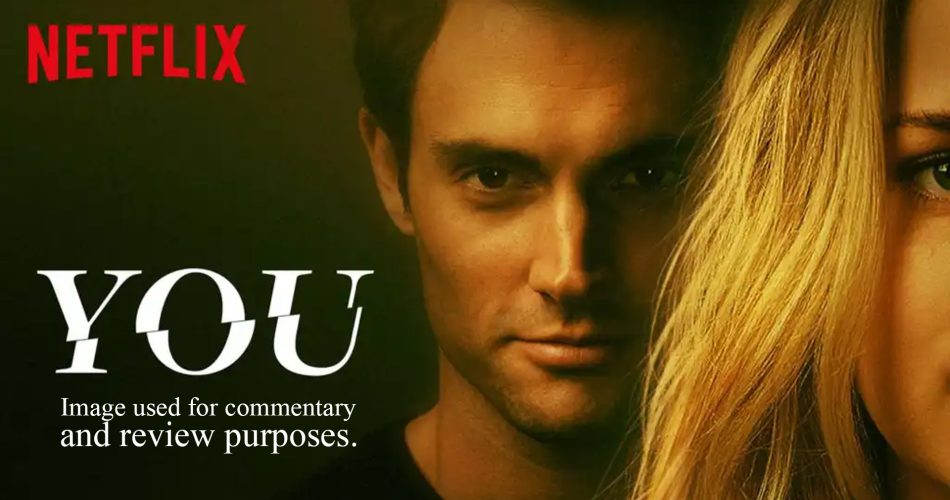
Joe Goldberg breaks into the apartment of the woman he’s in love with, goes through her laptop, and steals her phone so he can spy on her. And yet, millions of women have fallen for him.
Will YOU Be His Next Victim?
Netflix’s show YOU debuts as intensely as it’s marketed. From the very first episode, we meet — through the eyes of protagonist Joe — the beautiful and vulnerable Guinevere Beck. Joe is so captivated by this woman that he develops an obsession and follows her everywhere for months. He breaks into her apartment and snoops through her laptop, tails her on a night out with friends and saves her life at the subway, swipes her phone while playing the charming suitor, and kidnaps Benji, her boyfriend. All of this, as he explains in his inner monologue, in the name of perfect love.
What struck me from the very beginning about this unusual protagonist is that the paradox of his personality is entirely intentional. Joe is charming, well-read, but he’s also someone we watch commit all kinds of atrocities. He constantly pulls us back and forth between “this guy is actually kind of sweet” and “what the hell is wrong with him?!”
And the cherry on top of this confusing cake is his almost tender, protective relationship with Paco, the neglected little boy who lives across the hall. We see Joe lending him books, bringing him food, or simply being there with a kind word. For the viewer, it becomes nearly impossible to reconcile the image of Joe-the-creepy-stalker with Joe-the-kind-neighbor. And that’s exactly the point.
Unlike his victims, we have the advantage of hearing his thoughts and seeing everything he does, not just what he chooses to show to the world. We’re faced with a choice: do we see him as a monster, as a sick man… or do we fall for his charm too?
Judging by fan reactions, a lot of women do fall for him. So many that Penn Badgley himself has repeatedly started debates about how morally acceptable it is to like Joe, where we draw the line, and how we distinguish obsession from healthy love. After all, life imitates art; the story of Joe and Beck, though fictional, reflects fragments of many women’s reality. I think we all know at least one woman who fell in love with a man’s potential, with his good qualities, so deeply that she started softening his flaws, even the truly problematic ones. In the best cases, these situations end with a broken heart. In the worst, we hear about them on the news. The show shines an uncomfortable spotlight on exactly this issue.
So why do women fall for Joe?
For one thing, I think it’s very hard for us to accept the idea that the same person can be both good and bad. It’s much easier to slap a label on someone’s forehead — “good person” or “monster” — than to sit with the discomfort, with all the moral shades of grey. To accept that a person is a contradiction, that they hold both light and darkness. So instead, we try to cancel out one or the other, to make our lives and minds a little lighter.
I did this once, with a man. I was 21. I was in a relationship that wasn’t working anymore, and I was dragging it out like pushing a boulder uphill. I’d just finished college and was in that strange in-between space where you try to figure out how what you’ve been studying for years actually applies to the real job market. I didn’t know which direction I wanted to go, my parents were pressuring me quite a lot… and then, out of nowhere, a guy appeared who seemed, at the time, like he’d been sent straight from above.
He won me over quickly: he was good-looking, well-read, smart, older than me. I felt like he was the first person in my life who could truly see all of me. Sparks flew fast, and we felt like we were walking on cloud nine. With him in my life, I found the courage to leave my old relationship and leap into something new and exciting.
But what I couldn’t see back then was that the relationship had an obsessive quality I mistook for normal. Just a few red flags: he’d keep me on the phone all night without caring that I had to be up early the next morning. Sometimes he made me feel like a piece on his chessboard. I always felt like he was one step ahead of me, like he knew something I was missing. I was constantly on edge, haunted by the thought that I was just a game to him; so I started playing games and running strategies right back.
In hindsight, there were so many things wrong with that relationship, and I had labelled most of them as flirting and genuine attraction. In my eyes, I was living a love story with a tortured, misunderstood soul whom I intended to piece together like a puzzle. In reality, I was looking at him through rose-tinted glasses. I couldn’t accept that this intelligent, funny, tender man who saw me so clearly was, at the same time, deeply selfish and manipulative, to the point where he believed his own lies. How could I have had any kind of balanced view of someone who contradicted himself at every turn?
My mind demanded one or the other, but the answer, I learned later, wasn’t black or white.
And I don’t think I was alone in thinking this way. In fact, I think many of us have been taught, without even realizing it, to confuse intensity with love. How could women not fall for Joe when many have learned that trust in a relationship means having your partner’s phone password? Or when being told “I can’t live without you” feels romantic?
Even my mom — at 55 years old — while watching YOU with me, blurted out at one point, genuinely baffled:
“But he actually loves Beck, you know!”
And she’s not entirely wrong. Joe himself believes that what he does for Beck comes from love. But what I think is important to highlight is the difference between authentic love and the dysfunctional kind, built on illusions, fears, and insecurities. Joe loves through control, through obsession, all rooted in a visceral need to protect himself from pain, to know with certainty that the woman he chooses will never disappoint him. And the fact that we so easily read his behavior as romantic says something about us as a society: that we, just like Joe, have been conditioned to run from pain in relationships.
It’s nobody’s fault — from childhood we’re exposed to dysfunctional models of love, starting with our parents and extending to the messages in music, films, and books. The problem isn’t that these models exist, but rather our collective and individual perception of them. To what extent do we unconsciously accept them as love stories worth following? Do we even have a safe, healthy version of connection to use as our compass?
Words carry more weight than they seem. If you make a habit of calling obsessive behaviors proof of love, you might start accepting them in your own life as exactly that.
So, will you be his victim?
Maybe you already have been. Maybe, reading these words, you’ve recognized a face, a situation, a feeling you called something else at the time. I have. And it took me two years to understand what I’d lived through, because nobody tells you that obsession can look like devotion, that control can look like care, that fear of abandonment can look like deep love.
YOU is an uncomfortable mirror, one that, if you look closely enough, might show you your own reflection. Not in Joe, but in his victims. In their desire to believe they are loved. In their ability to see what they want to see.
I don’t know if there’s a foolproof recipe against situations like these. But I think the first step is simple, even if it isn’t easy: learn to tell the difference between what you feel and what is real. Between the story you tell yourself about someone and the person who’s actually standing in front of you.
Your Joe won’t look like Joe Goldberg. He’ll be more subtle, more convincing and most likely, he’ll make you feel seen like never before.

