
How do you understand an animal’s wisdom?
The question often finds its most simple answer in the material world: learn their behavior, understand their signals, notice how they express comfort, fear, curiosity, affection and so on. But I will argue that there is also another side to this understanding, one I can only call spiritual. Once you access that dimension, animals stop being background characters in your life and become more like mirrors, sometimes even teachers.
Animals have always been an integral part of my life since I was very young. Growing up, I was a bit of a solitary child, and so I often found myself spending long stretches of time around animals rather than people. Cats — many cats! — dogs, birds, horses. I spent hours absorbing their moods, their boundaries and their rituals, and what I quickly learned was that animals are never as “simple” as people like to imagine. There is a lot of ground to cover here, but what surprised me most about them was their ability to evolve inside the bond they share with a human being. When there is genuine resonance, attachment becomes incredibly deep. Not in the sentimental sense, but deeply significant, almost psychic.
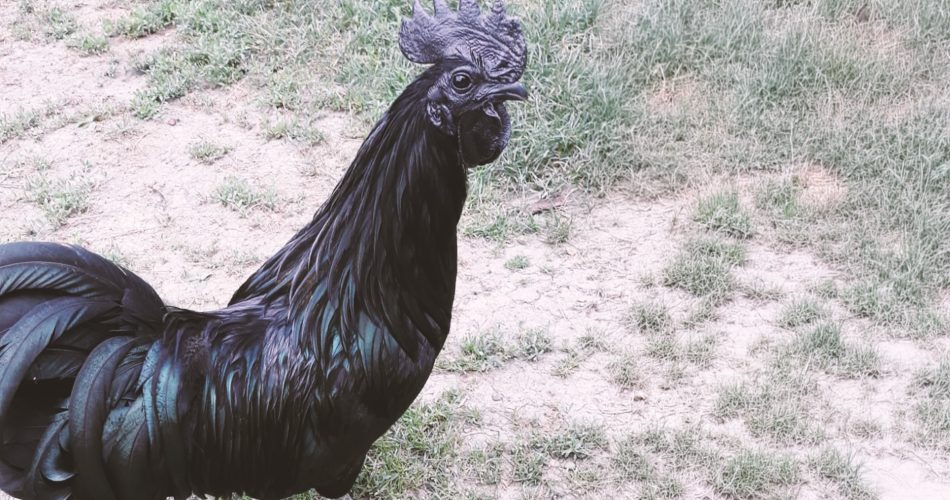
I plan to speak about many other types of animals in future posts, because each species carries its own wisdom and deserves its own space. The one I will be writing about today, though, is the rooster, governed by Coco, my black Ayam Cemani rooster whom I loved very much.
At first, black roosters intrigued me because I liked the symbolism they represented. Anyone who knows me knows I have always been drawn to the mystical, the occult, the beautiful things that feel slightly otherworldly. A black rooster already comes carrying its own mythology. But beyond the symbolism, I discovered a creature who was intelligent, compassionate, strange, and full of personality.
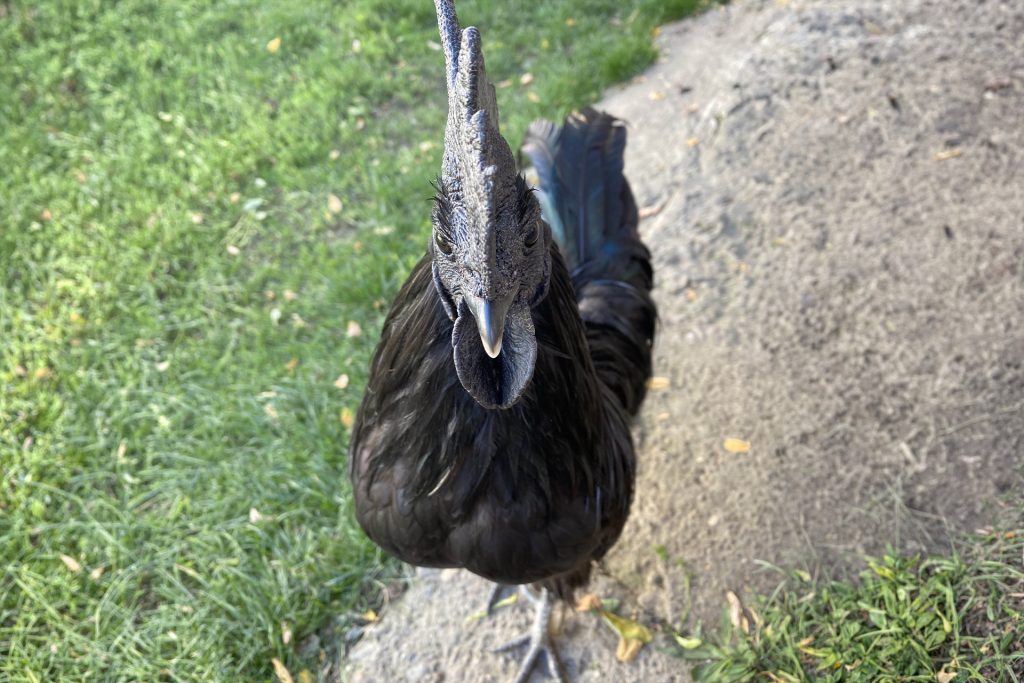
I raised Coco from the moment he first came out of the egg. For a while he lived with me in my apartment, and later we moved to a house in the countryside for the summer, in a village not far from where I live. In almost no time, we became inseparable; he would come to me when he heard my voice, he asked me for affection (he liked it when I stroked his comb and his cheeks), he loved being held… he even had this ridiculous habit of jumping onto my head and staying there! It was charming in theory, but painful in practice because he would grip my scalp with his claws to keep his balance. During our play sessions, I often wore a beanie just to avoid being scratched to death by love.
His feathers were a deep, glossy black with that beautiful greenish sheen some black plumage catches in the light, and there was something about his eyes that always unsettled me in the best possible way.
People say birds can sense things before we do. I cannot prove that with hard facts, but I know what I felt when I stared into his eyes for too long. Eye contact with Coco gave me a very unusual state of mind, almost as though I had stepped briefly into another dimension. It felt as if his beady eyes held an intelligence that exceeded the limits of his physical form. It felt nothing like rational intelligence or language as we know it, but rather like something ancient and concentrated. It seemed to say: I understand more than you think. I know more than this body allows me to express. We have known each other longer than this life.
That may sound dramatic to some people, but anyone who has ever been truly seen by an animal knows what I mean. And science is here to back it up.
Research has increasingly challenged the old stereotype that chickens are dull or mechanical animals. Reviews of the literature describe them as cognitively, emotionally, and socially complex, with evidence of individual personalities, social learning, self-control, emotional sensitivity, and sophisticated communication (Marino, 2017). In other words, Coco’s depth was not just my projection. Chickens are far more aware than most people give them credit for.
I think one of the biggest mistakes we make as humans is assuming that only certain animals are capable of meaningful bonds. Dogs, yes. Cats, maybe. Horses, of course. But a rooster? A pigeon? A rabbit? A parrot? A fish? People become skeptical the moment the animal falls outside the usual hierarchy of “real pets.” Yet reviews on non-conventional companion animals suggest that meaningful human benefit is not limited to dogs and cats. Bonds with birds and other less conventional companions can still offer emotional, psychological, and social value, even if the research base is smaller and still developing (Macauley & Chur-Hansen, 2023).
And I can tell you that, to some extent, it’s true, because Coco was never “just a rooster” to me. He was a loyal, loving companion, and our connection definitely shaped some aspects of who I am today.
A growing body of research suggests that relationships with animals can support adults through companionship, stress regulation, social support, and coping during difficult periods (Macauley & Chur-Hansen, 2023; Shoesmith et al., 2021). In children, pet bonds have been associated with empathy, compassion, social competence, self-esteem and improvement in loneliness and quality of life (Groenewoud et al., 2023; Hawkins et al., 2017; Purewal et al., 2017). Again and again, animals appear in people’s lives as reliable companions, not just as a furry or feathered being depending on our care.
So, what is it about animals that make them such good companions?
For me, interacting with animals has always felt like it’s bringing me back to a language older than speech. Animals can teach us presence, consistency, and paying attention to the kind of communication that doesn’t rely on words.
If you want a deeper relationship with your pet, whatever species they are, I think it begins with presence and careful observation, but out of a place of curiosity rather than control. Most people meet animals with a script already prepared: how they want the animal to behave, how affection should look, what kind of companionship “counts.” But animals don’t care for our fantasy of them. They don’t know how we perceive them; they are only here, on Earth, as themselves. And true connection with an animal can only form once you allow yourself to see them as such.
In practical terms, that could be watching their rhythms without forcing meaning too quickly. Learning what safety looks like in their body, learning to distinguish moments when they genuinely enjoy spending time with you from moments when they’re merely tolerating you. Noticing what kind of touch they seek, if any. Noticing when they come closer, when they pull back, what tone of voice softens them, what routine relaxes them, what play genuinely lights them up.
It also means consistency, because animals don’t understand words, so they can only trust pattern and repetition. Animals trust the person who shows up in a recognizable way, so feed them with presence. Speak to them even when they cannot answer in words. When you touch them or interact with them, do so from a place of calm and respect. And, maybe most importantly, stop assuming intelligence must always be spoken word to be real.
Some animals are overtly affectionate, others are subtle. Some comfort you physically, others simply sit near you and alter the emotional atmosphere of a room. Some seem to comfort you when you’re sad. Some confront you with your impatience, your nervousness, your need to be in control. I have come to believe that every relationship we share with an animal reveals something about us.
Coco revealed tenderness in me; curiosity, playfulness and reverence. But he also revealed grief.
I had to leave the village for a while, and it was not something I could postpone. When I came back, I learned that he had died, most likely of old age, though I also suspect loneliness may have played a part. He lived around five years, which is not a short life for a rooster, and it was certainly a life full of far more extravagance than most roosters ever get. Still, I felt guilty. Loss has a way of finding the one sentence that hurts most: I should have been there.
I understand that sentence, but now I also know it is not the whole truth.
The whole truth is that he was loved and seen deeply. He had a life shaped by attention, affection, play, and connection. And perhaps that is the most any being can ask for here.
What Coco left me with was not only memory, but a way of seeing. He helped me understand that animals are deeply spiritual beings, not lesser souls moving through empty instinct. They carry personality, presence, and what I can only call energy. Sometimes soft, sometimes mischievous, sometimes regal, sometimes mysterious. Sometimes wiser than the humans caring for them.
Animals aren’t just little saints sent here to heal us. Connection with them is something far more intimate than that; the realization that another being, without sharing our language, can still know us, shape us, comfort us, and remind us that consciousness comes in many forms.
Coco did that for me.
To this day, when I think of him, I do not only think of a black rooster with shining feathers and an absurd love of sitting on my head. I think of mystery, a recognition, a soul with feathers colliding with mine for a little while and leaving me different than he found me.
References
Groenewoud, D., Enders-Slegers, M.-J., Leontjevas, R., van Dijke, A., de Winkel, T., & Hediger, K. (2023). Children’s bond with companion animals and associations with psychosocial health: A systematic review. Frontiers in Psychology, 14, 1120000.
https://doi.org/10.3389/fpsyg.2023.1120000
Hawkins, R. D., Williams, J. M., & Scottish Society for the Prevention of Cruelty to Animals. (2017). Childhood attachment to pets: Associations between pet attachment, attitudes to animals, compassion, and humane behaviour. International Journal of Environmental Research and Public Health, 14(5), 490. https://doi.org/10.3390/ijerph14050490
Macauley, L., & Chur-Hansen, A. (2023). Human health benefits of non-conventional companion animals: A narrative review. Animals, 13(1), 28. https://doi.org/10.3390/ani13010028
Marino, L. (2017). Thinking chickens: A review of cognition, emotion, and behavior in the domestic chicken. Animal Cognition, 20, 127–147. https://doi.org/10.1007/s10071-016-1064-4
Purewal, R., Christley, R., Kordas, K., Joinson, C., Meints, K., Gee, N., & Westgarth, C. (2017). Companion animals and child/adolescent development: A systematic review of the evidence. International Journal of Environmental Research and Public Health, 14(3), 234. https://doi.org/10.3390/ijerph14030234
Shoesmith, E., Shahab, L., Kale, D., Mills, D. S., Reeve, C., Toner, P., Santos de Assis, L., & Ratschen, E. (2021). The influence of human–animal interactions on mental and physical health during the first COVID-19 lockdown phase in the U.K.: A qualitative exploration. International Journal of Environmental Research and Public Health, 18(3), 976. https://doi.org/10.3390/ijerph18030976

